
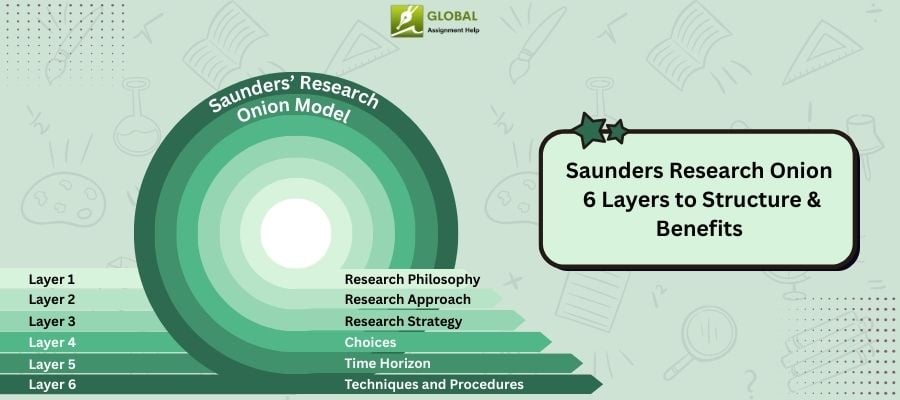
Have you ever stared at your research and paused while thinking, “Where do I begin?” Choosing the suitable philosophy, research method, and approach can feel like trying to solve a cube blindly. This is where the Saunders Research Onion comes to the rescue. With its six layers, it can give you a step-by-step road map. And with a simple diagram, practical tips and real guidance, what once seems difficult becomes completely doable. In this guide, we will walk through Saunders’ Research Onion and break down difficult research layers so students can tackle them.
What is Saunders’ Research Onion?
The Saunders’ Research Onion is a structured framework used in research methodology to guide the design of a study. It categorises the research process into six layers, helping students and researchers plan, justify, and execute their research in a logical and step-by-step way.
However, the Saunders’ Research Onion is not perfect, but it is a useful tool for thinking holistically about methodology. It assists you in knowing what decisions you need to make in terms of your research design and methodology.
Here is the Saunders Research Onion diagram for reference:
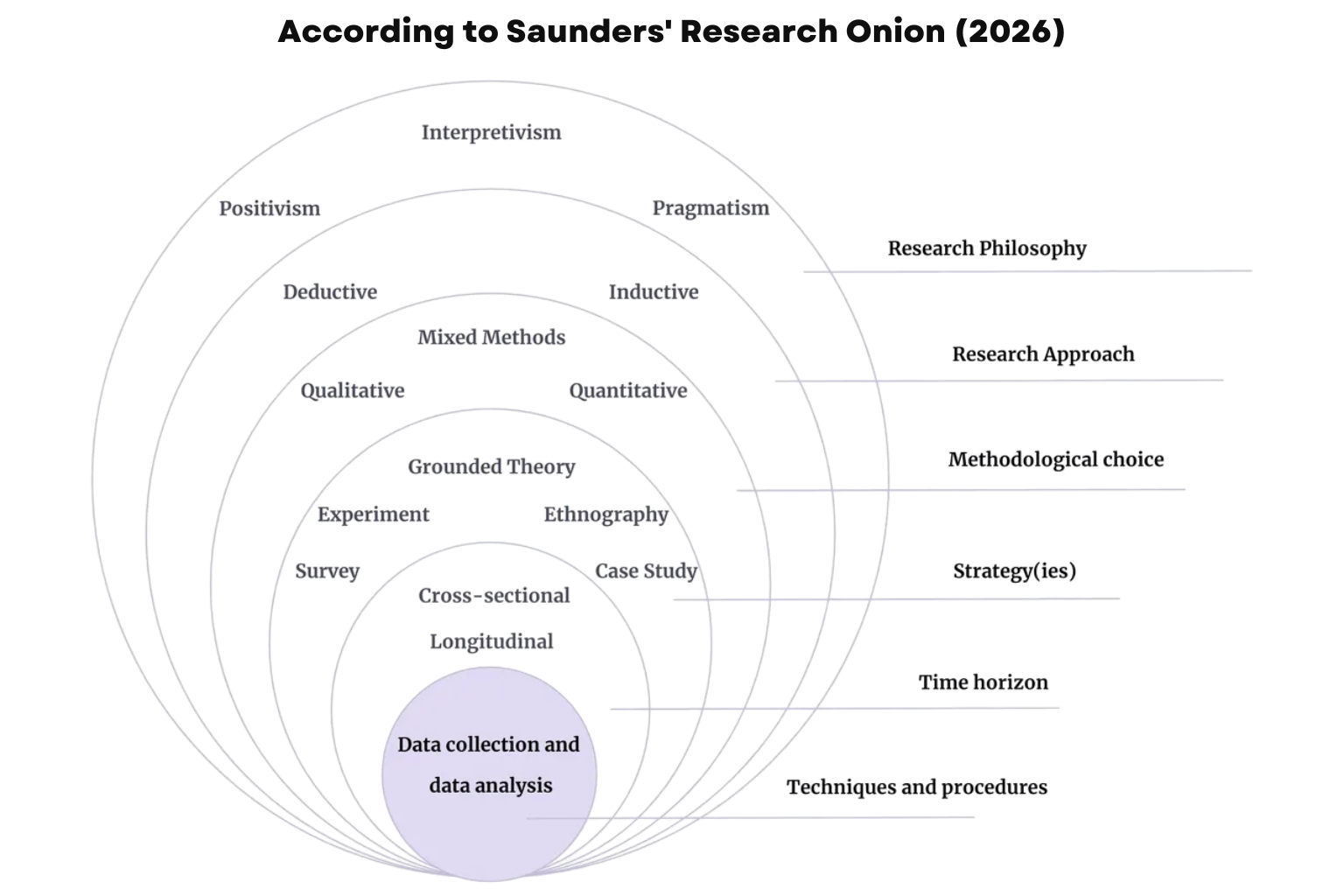
Layers of Saunders’ Onion Model
Now, with the help of professional assignment help, let us explore the six different layers of the Saunders Onion in brief:
Layer 1: Research Philosophy
Research philosophy refers to what scientists believe constitutes acceptable knowledge. Having said that, your philosophy is influenced by your beliefs, but it is also something that you can learn about and then adapt according to your topic and research question.
Research philosophy can be divided into three main categories, which are as follows:
Positivism
Positivism observes information and data as factual, objective and detached from any biases or other influences. It can either be true or false. For example: “I don’t want opinions, give me the facts!”
Interpretivism
Next, in different layers of Saunders' research onion, in interpretivism, a deeper understanding of a problem is needed. They believe raw data and numbers only scratch the surface and follow the principle that says reality is shaped by people’s subjective experiences and social contexts.
Pragmatism
Pragmatism uses a flexible approach, wherein you can do whatever helps you in achieving an answer to your question. You don't have to stick with one way of thinking.
For example: “I'll use whatever works!”
Layer 2: Research Approach
The next step is to decide whether you are going to test hypotheses through a deductive or inductive approach. In the inductive approach, you observe patterns to make generalisations, whereas in the deductive approach, you need to create hypotheses and test them accordingly.
Below is the comparison between the inductive and deductive approaches:
|
Aspect |
Inductive Approach |
Deductive Approach |
|
Basic Idea |
Develops new theories or models from observations and collected data. |
Tests or applies an existing theory or model in a specific context. |
|
Starting Point |
Begins with real-world observations or experiences. |
Begins with an established theory or framework from the literature. |
|
Process |
Observe → Collect data → Analyse patterns → Develop a new model or theory. |
Select theory → Apply/test it in practice → Evaluate whether it works. |
|
Example Scenario |
A team leader studying their own remote team’s workflow and creating a new task management model based on observed success. |
A team leader is applying the Getting Things Done (GTD) method by David Allen to see if it works effectively in their team. |
|
Purpose |
To generate new knowledge or models when none exist. |
To validate or extend existing theories in new contexts. |
|
Outcome |
Creation of a new task management model that other teams can use. |
Evidence showing whether an existing model is applicable or effective in a specific setting. |
Layer 3: Research Strategy
This layer of the research onion expresses how the research can be conducted based on a study. Outside the onion, these strategies are referred to as the research designs and below is a brief about these:
Experimental Research
It investigates cause and effect relationships, and researchers manipulate an independent variable to observe its effect on the dependent variable. To ensure the validity and reliability of results, experimental research uses a control group in a controlled setting.
Action Research
Action research is ideally conducted in a practical setting, like a classroom, a hospital, a workspace, etc. Action research helps to inform researchers of problems or weaknesses related to interactions within the real world. In action research, there is a strong focus on the participants, which is why it is sometimes referred to as “participatory action research” or PAR.
Case Study Research
A case study is a detailed, in-depth study of a single subject, like a person, a group, an institution, or an event, phenomenon or issue. In this type of research, the subject is analysed to gain an in-depth knowledge of issues in a real-life setting. The real objective here is to gain an in-depth understanding within the context of the study.
Grounded Theory
Grounded theory is basically qualitative and takes an inductive approach. This form of research involves identifying commodities between sets of data, and results are then drawn from completed research without the aim of fitting the findings into a pre-existing framework.
Ethnography
Ethnography involves observing people in their natural setting and drawing meaning from their cultural interactions. The objective is to capture the subjective experiences of participants, to see the world from their perspective.
Archival Research
An archival research strategy draws from the kind of materials that already exist, and meaning is then established through a review of the existing data. This method is particularly suitable for historical research and can make use of materials such as manuscripts and records.
Read Sample - Understanding Saunders Research Onion | Stages Explained
Layer 4: Choices
The next layer of the research onion is basically about deciding how many data types you will use in your research. And there are three major options, like mono, mixed and multi-method.
- In the mono method, you will make use of one data type, either quantitative or qualitative.
- In mixed methods, both qualitative and quantitative approaches are used.
- Lastly, in a multi-method approach, you would make a wider range of approaches.
Layer 5: Time Horizon
The time horizon describes how many points in time you plan to collect your data. Here, two options exist, one being the cross-sectional and longitudinal time horizon.
For example:
1. Longitudinal time horizon: To study the language of memes- need to collect data over multiple points in time, maybe over a few weeks, months, or even years.
2. Cross-sectional time horizon: For studying the language at a certain point in time, we need to gather the data at a snapshot point in time.
Layer 6: Techniques and Procedures
This is the centre of the onion, where you get down to the actual practicalities of your research to make choices with respect to specific techniques and procedures. It is crucial to align these choices with the previous layers of the onion and the overarching research aims and questions.
These points to be considered:
- Data types
- Data collection
- Sample size
- Data analysis
The Saunders Research Onion model gives you a foundational framework to follow in determining your research design. These layers are structured to ensure coherence between all choices, which ultimately makes your methodology clearer. In the upcoming section, you will walk through how to write research with minimal error.
How to Write the Saunders Research Onion Without Errors?
Writing a methodology chapter using Saunders Research Onion can sometimes feel challenging for students. In that case, seeking business assignment help can guide you in structuring your research design correctly without errors.
- Firstly, start with the outer layers, i.e., research philosophy and justify your choice, positivism, interpretivism or pragmatism.
- Secondly, explain your research approach and strategy very properly, ensuring alignment with your philosophy.
- Covers choices, time horizon, and techniques, shows how each layer connects logically and analytically.
- Must include diagrams or visual aids to illustrate the Onion properly.
- It offers real examples to support your explanations.
- Try to avoid skipping layers, vague reasoning, or inconsistent methods.
- Give some time to proofread to maintain academic tone, correct terminology and coherence.
By following this structured approach to the Saunders Research Onion explanation, write a logical, clear and error-free methodology chapter.
Benefits of Saunders’ Onion Model
The Saunders Research Onion is an organised framework that makes the overall process more streamlined and effective. Below are the other benefits of Saunders’ Onion Model:
- Clarity: Saunders’ Onion Model simplifies complex research design components into feasible layers. This is how students can work their way through each level, rendering the research process considerably less daunting.
- Consistency: Every layer logically follows on from the preceding one. This develops the concordance between your research philosophy, strategy and data collection techniques, serving to produce an orderly methodology that is academically acceptable.
- Flexibility: Though with its structure, the model is not permanent. Whether carrying out scientific tests or qualitative social research, Saunders Onion can help shape your requirements.
- Credibility: Applying Saunders’ model shows that research choices are informed by an accepted framework, highlights academic maturity and increases the trustworthiness of your results.
However, if you are still not clear about the advantages of the Saunders Onion model, then you can take management assignment help for better writing with structure.
Conclusion
The Saunders Research Onion offers a clear and structured framework that helps students design research methodology in an organised way. By going through six layers, researchers can make informed decisions that align with research aims and questions. This model simplifies complex methodological choices but also improves the clarity, consistency and credibility of a study. Whether you are conducting qualitative or quantitative research, the Saunders Research Onion acts as a practical guide for developing a well-structured methodology chapter. Understanding and applying this model can ultimately help students produce stronger, more reliable and academically sound research.
Read More - Reliability Vs Validity in Research | Types, Comparison and Examples
Place Your OrderFrequently Asked Questions
Q1. What is the Saunders Research Onion with an Example?
Saunders Research Onion is a six-layer framework guiding research design. For Example, a student choosing positivism, a case study strategy, and structured interviews follows its step-by-step layers for structure.
Q2. Is Saunders Research Onion Suitable For Qualitative Research?
Absolutely yes! The Onion offers qualitative research by guiding philosophy, approach, strategy and data collection methods, helping students in interviews, observation or ethnographic studies systematically.
Q3. What is the Difference Between Research Philosophy And Research Approach In Saunders’ Research Onion?
Research philosophy describes the worldview aspect, like positivism and interpretivism, whereas research approach determines reasoning, like deductive and inductive. So it can be said that philosophy guides the lens, and the approach guides how theory and evidence are connected during research.
Q4. Why use Saunders Research Onion in a Dissertation?
It offers a well-structured road map, assisting students to justify methodology, opt for appropriate strategies, and organise data collection logically, making dissertations coherent, scholarly, credible and easier to write.
Free Tools

Easy to Use Paraphrasing Tool to Simplify Complex Academic Writing
Check Now


Get Structured Outline by Professionals for Your Dissertation
Check Now
Effortlessly manage citations and references with our smart referencing tool
Check Now










- Plagiarism
- Pricing
- Order Now
- Call Back
- Live Chat
 Whatsapp
 Call
Call  Email
Email 




Limited Time Offer
Exclusive Library Membership + Free 300$ Wallet Balance




Get $300 Now
 Update your Number



Thank you for submitting your comment on this blog. It is under approval. We will carefully review your submission and post it on the website.